
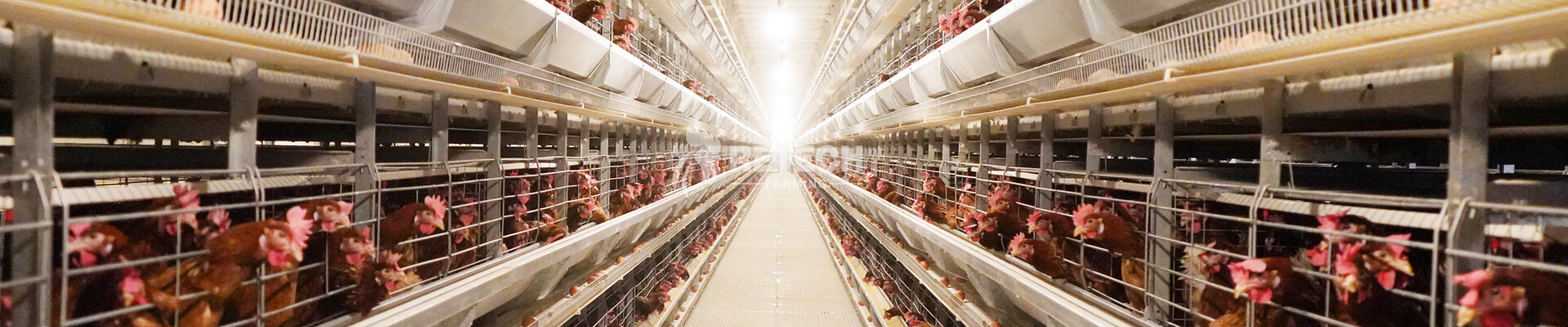
In large-scale layer and broiler farming, chicken manure treatment not only relates to the farm’s environmental compliance but also directly impacts labor costs, land use, transportation costs, and profits.
Currently, the most common chicken manure treatment methods include:
1. Composting
2. Fermentation tank
3. Chicken manure air drying or oven drying
4. Biogas fermentation and biogas power generation.
These four processes differ significantly in their treatment principles, investment costs, land area requirements, operating energy consumption, odor control, and final products. When making a selection, one should not only consider the equipment price but also comprehensively consider the scale of the farm, the moisture content of the chicken manure, site conditions, surrounding environment, environmental requirements, and subsequent sales or land return channels.
1. Comparison of Four Chicken Manure Treatment Methods
| Treatment methods | Main principles | Investment level | Land requirements | Operating energy consumption | Odor control | Applicable scenarios |
| Composting | Aerobic fermentation, turning and aeration | Lower | Larger | Lower | Generally, proper sealing and deodorization are necessary. | Small and medium-sized chicken farms with ample space |
| Closed-loop fermentation tank | Closed aerobic fermentation, automatic aeration and stirring | Higher | Smaller | Medium | It’s better for centralized collection and treatment. | Large chicken farms, areas with high environmental requirements or limited space |
| Chicken manure air drying/baking | Rapid dehydration, reducing moisture content | Low to Medium | Smaller | Higher | Dust and odor control systems are required. | Temporary treatment, reduced transportation volume, short-term transition |
| Biogas fermentation power generation | Anaerobic fermentation, producing biogas and utilizing it as a resource | Higher | Larger | Medium | It depends on the system’s airtightness. | Industry parks with integrated farming and breeding, large wastewater volumes, and energy utilization capabilities |
2. Composting Fermentation: Low Investment, Simple Operation, Suitable for Small and Medium-Sized Chicken Farms
Composting fermentation is a relatively mature aerobic fermentation method for chicken manure treatment. Its working principle involves mixing fresh chicken manure with straw, sawdust, rice husks, and other auxiliary materials in a specific ratio, regularly turning the compost, and aerating it to promote the reproduction of aerobic microorganisms and generate high temperatures, thereby achieving sterilization, maturation, and dehydration of the chicken manure.
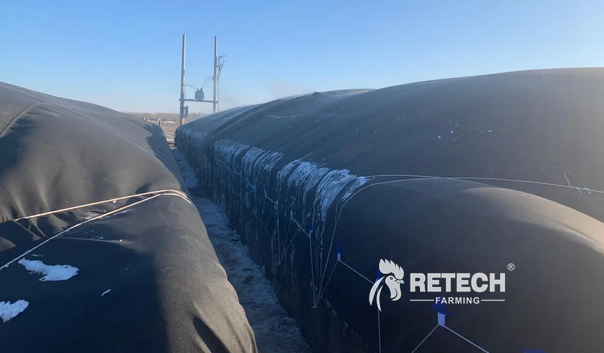
After a fermentation cycle of approximately 15-20 days, the chicken manure can be transformed into a relatively stable organic fertilizer raw material, which can be sold directly or used for land application.
Advantages
· Lower investment cost
· Simple equipment structure, convenient operation and maintenance
· Low technical threshold
· Suitable for most small and medium-sized farms
Disadvantages
· Relatively long fermentation cycle
· Requires a large area of land
· Obvious odors during open or semi-open operations
· Easily affected by environmental factors such as temperature and rainfall
3. Closed-Loop Fermentation Tank: High Efficiency, Low Odor, Suitable for Environmentally Controlled Areas and Large-Scale Chicken Farms
Closed-loop fermentation tanks are modern, intelligent chicken manure treatment equipment with a fully enclosed tank structure. Fresh chicken manure can be directly transported into the fermentation tank, where high-temperature aerobic fermentation is completed under the action of intelligent temperature control, automatic aeration, continuous stirring, and deodorization systems.
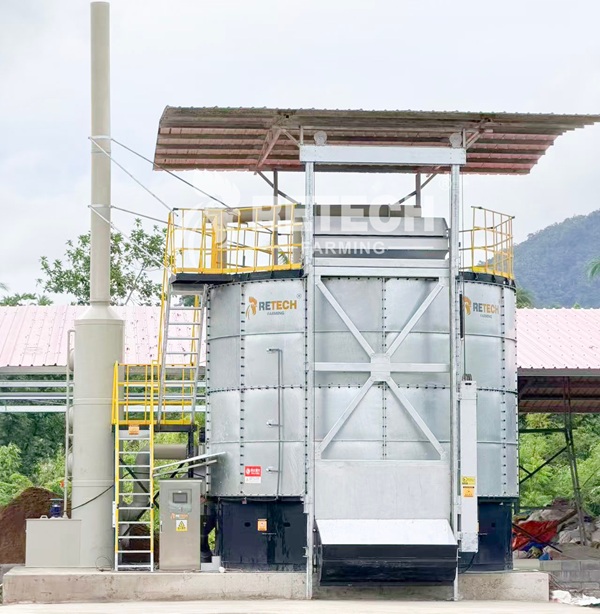
The entire process operates in a closed environment, and exhaust gases and odors can be collected and treated uniformly before being discharged in compliance with standards. Therefore, it is widely used in areas with high environmental requirements and strict odor control.
Core Advantages
· Small footprint
· High fermentation efficiency
· Less affected by weather
· Excellent odor control
· More conducive to environmental acceptance
Main Disadvantages
· Higher initial investment
· Higher requirements for operation and maintenance management
· More suitable for large and medium-sized breeding enterprises with stable output
Retech Farming Closed Fermentation Tank Solution
For larger poultry farms, Retech Farming provides vertical closed aerobic fermentation tanks designed to process large quantities of chicken manure in a relatively compact area.
In Retech’s current configuration, the fermentation tank is approximately 6 meters in diameter and 8.6 meters high, with a volume of approximately 110 m³. The stated manure holding capacity is approximately 88–90 tons, depending on manure characteristics and operating conditions.
The system can be configured with aeration and hot-air equipment. Retech’s project configuration uses a hot-air blower, with operating air temperatures of approximately 65–70°C. The purpose of the high-temperature stage is to support moisture reduction and pathogen reduction; actual treatment performance depends on temperature, exposure time, manure characteristics, and operating conditions.
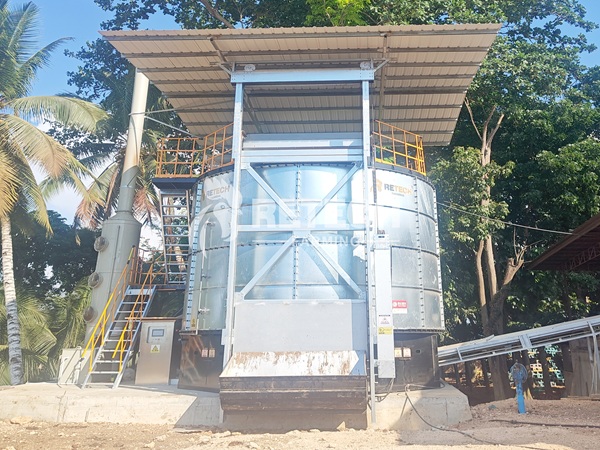
The fermentation cycle is approximately 7–10 days under the referenced operating configuration, rather than being treated as a universal cycle time for every farm.
Retech has deployed fermentation-tank solutions in poultry projects in markets including the Philippines, Nigeria, Kenya, and Ghana.
Why does a vertical fermentation tank make sense for large poultry farms?
The main advantage is not simply the size of the tank. It is the combination of:
large manure volume + limited land + controlled fermentation + centralized operation.
For example, a farm producing several tons of manure every day may find that conventional open composting requires substantial space for storage, turning, and curing. A vertical fermentation system can concentrate the treatment process into a much smaller footprint.
For farms with 50,000 chickens or more, it is worth calculating the daily manure output, available land, local odor requirements, electricity/heat costs, and final fertilizer utilization before selecting a fermentation system.
4. Chicken Manure Air Drying: Fast, but Not Suitable as a Long-Term Primary Solution
Chicken manure air drying primarily uses high-temperature air drying or baking equipment to rapidly reduce the moisture content of chicken manure, transforming it from a highly moist and easily perishable state into dry chicken manure that is easier to store and transport.
Advantages
· Simple process
· Fast start-up
· Relatively low initial equipment investment
· Suitable for temporary emergency treatment
Disadvantages
· High energy consumption and operating costs
· Only dehydration is achieved, not thorough composting and sterilization
· Potential for residual insect eggs and pathogens
· Prone to secondary fermentation, mold, and foul odor after absorbing moisture
· Risk of secondary pollution
5. Biogas Power Generation: A Circular Utilization Solution for Integrated Farming and Livestock Production
Biogas power generation is a typical anaerobic fermentation resource utilization process. The core idea is to collect chicken manure and livestock wastewater and send them into a closed anaerobic fermentation system. In an anaerobic environment, microorganisms decompose organic matter to produce biogas, which is then converted into electricity and heat by a biogas generator.
The fermented biogas residue and liquid can also be used as organic fertilizer in orchards, farmland, and seedling bases, thus forming a circular agricultural model of “livestock farming—fermentation—power generation—returning to the field.”
Advantages
· Achieves energy utilization from manure
· Can reduce some energy costs
· Facilitates integrated farming and livestock production and resource recycling
· Suitable for creating a closed-loop agricultural system
Disadvantages
· High requirements for raw material quantity and continuity
· Large initial investment
· Complex system
· Not suitable for all farms
6.Conclusion: How to Choose the Right Chicken Manure Treatment Method for Different Sizes?
Choosing a chicken manure treatment method is essentially a comprehensive balance of cost, environmental protection, efficiency, site availability, and profit model.
Small-scale farms and ordinary small to medium-sized chicken farms: Composting and fermentation; low investment, easy operation and maintenance, stable and compliant, suitable for most ordinary farms.
Located near residential areas, in areas with strict environmental control, and large-scale standardized chicken farms: Prefer closed fermentation tanks; no odor or secondary pollution throughout the process, zero pressure for environmental acceptance.
Farms with their own farmland, orchards, or planting bases: Prioritize biogas power generation to achieve energy self-sufficiency and return manure to the fields, creating a closed-loop circular agriculture.
For temporary manure treatment or short-term transitional scenarios: Chicken manure air drying technology can be used, but it is absolutely not recommended as a long-term primary treatment solution.
7.FAQ
Q1: What is the most environmentally friendly method for chicken manure treatment?
A: For large-scale farms, closed fermentation tanks are generally more suitable for strict environmental control requirements, especially in countries like the Philippines, Indonesia, Thailand, and Malaysia.
Q2: Can chicken manure be directly air-dried?
A: Yes, but air-drying only solves the dehydration problem, not the harmless treatment. Long-term use is not recommended.
Q3: How long does chicken manure fermentation take?
A: Retech’s fermentation tanks require 7-10 days of fermentation time, depending on the equipment and process.
Q4: Which treatment method is suitable for large-scale layer/broiler farms?
A: Generally, closed fermentation tanks are preferred due to their high cost-effectiveness and ease of operation.
Author
Kelly, Project Manager
WhatsApp: +8617685886881
Email: director@retechfarming.com
LinkedIn: https://www.linkedin.com/in/kelly-li-556465254/
Post time: Sep-21-2026


