
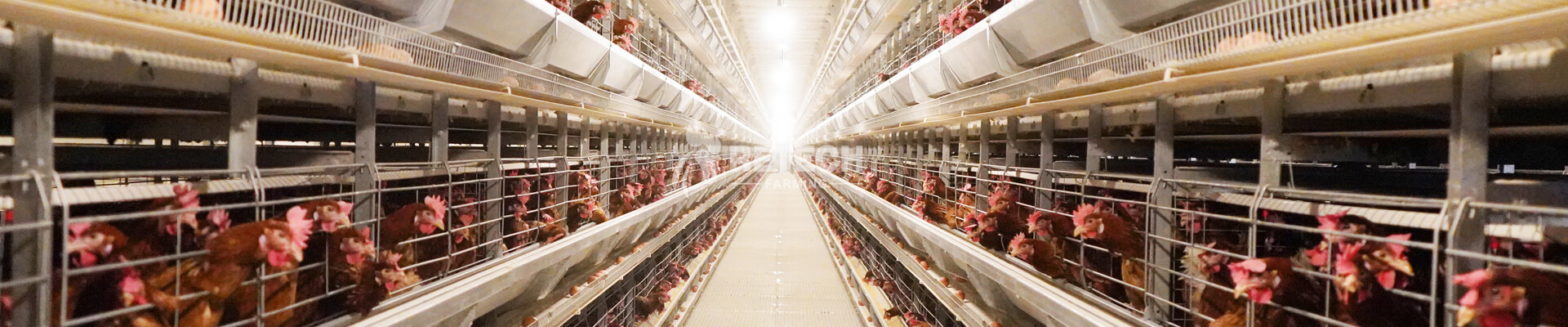
This involves multiple aspects, including investment capacity, chicken house conditions, breed adaptability, feeding management, disease control, and sales models. For farmers preparing to upgrade their farming methods, analyzing the key aspects to evaluate when transitioning from free-range to automated broiler cage farming is crucial.
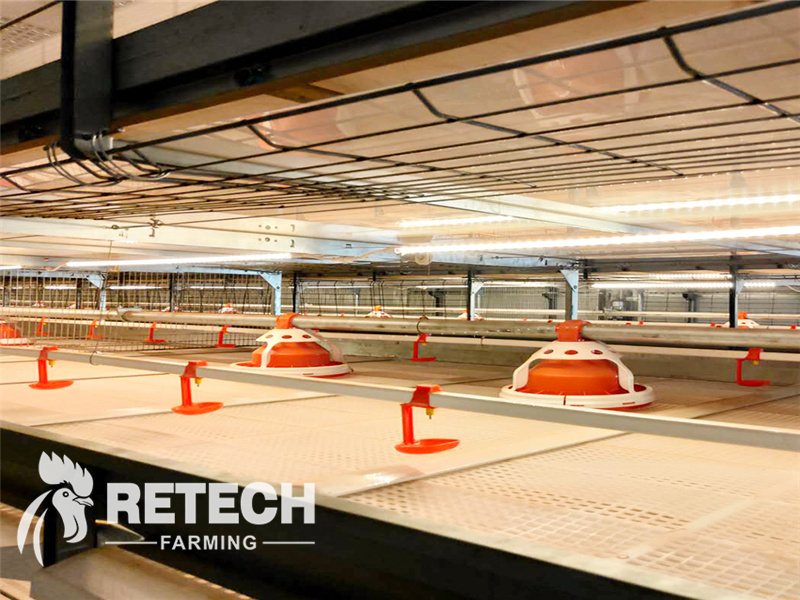
Why switch from free-range to automated cage farming?
1.Free-range and floor-raised chickens typically require significant manual labor for the following tasks:
Feeding and watering
Cleaning chicken manure and bedding
Picking and handling chickens
Observing the flock’s condition
Statistics on mortality and number of chickens sold
Addressing equipment and environmental issues. While manual labor may be acceptable for smaller chicken houses, it often becomes a significant long-term cost component when the scale of farming expands to tens or even hundreds of thousands of chickens.
Automated broiler cage farming systems centralize the management of feeding, watering, manure removal, and environmental control, reducing repetitive labor and allowing limited personnel to manage larger flocks.
2. Is the chicken house utilization rate low enough?
The number of chickens that can be raised per square meter on the ground is limited, and the chickens have a large activity area and the feces are easily dispersed. Automated multi-layer cages can make full use of the vertical space of the chicken house and increase the stocking capacity under the same building area.
However, farmers should not only look at the theoretical loading capacity, but also consider:
House height
Ventilation conditions
Fire and safety requirements
Equipment maintenance space
Chicken growth stage
Local breeding density specifications
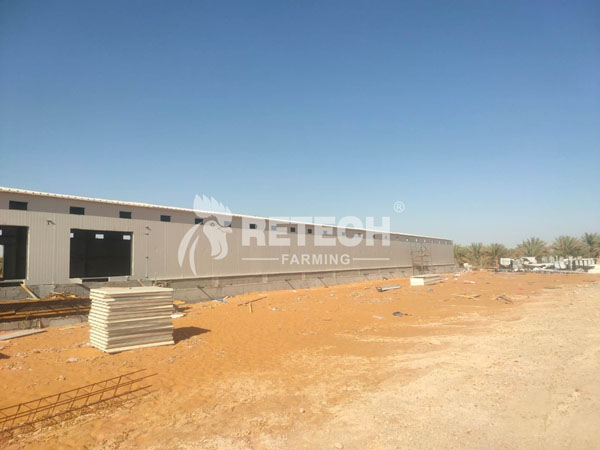
3.Can the chicken coop conditions be modified? The requirements for old free-range sheds and automated cage sheds are completely different. Key considerations:
Can the eaves height, span, and load-bearing capacity accommodate stacked cages?
Can the ground provide drainage, moisture protection, and load-bearing capacity?
Are there enough ventilation windows, fan locations, and air inlets?
Is the power capacity sufficient, and is the voltage stable?
Can the walkways, loading area, and manure removal truck access the coop?
Is the insulation adequate? Will the chickens die from overheating in summer?
Some old shed renovations cost more than new construction. If the shed is too low, too narrow, or has insufficient load-bearing capacity, drastic modifications often lead to more problems later.
Automated systems aren’t necessarily better the more expensive they are; the key is matching the system’s specifications. The core equipment for automated broiler cage rearing includes feeding, watering, manure removal, environmental control, and alarm systems. When evaluating, consider four points:
1. Stability: What is the failure rate? Are spare parts readily available?
2. After-sales service: Are there local service personnel available, and how long will it take to arrive?
3. Alarms: Can the system trigger telephone alarms for power outages, high temperatures, and fan failures?
4. Scalability: Can the system be compatible with future additions of cages or floors?
Environmental Control System
Automated broiler farming typically requires fans, evaporative cooling pads, air inlets, heating equipment, temperature and humidity sensors, and control cabinets.
Environmental control should focus on:
* Summer cooling capacity
* Winter insulation capacity
* Emergency measures after power outages
* Whether ventilation volume matches the number of chickens in the house
* Sensor accuracy
* Ease of operation of the control system
* Remote alarm functionality
The more complex the automated system, the greater its reliance on a stable power supply and after-sales service. It is recommended that farmers equip themselves with generators or backup power supplies and develop contingency plans in advance for power outages, water outages, and equipment failures.
If I’m planning to renovate my chicken coop in Nigeria, what services can Retech provide?
Customized Design for the Nigerian Climate
Nigeria’s climate is characterized by high temperatures, heavy rainfall, and unstable power supply in some areas. Retech doesn’t just sell equipment; they typically offer:
Chicken Coop Layout Planning: Based on your land area and farm size, they design the orientation and structure of the chicken coop best suited to the local climate to maximize natural ventilation and reduce reliance on air conditioning.
Environmental Control System Solutions: Addressing Nigeria’s high temperatures, they configure efficient evaporative cooling systems and negative pressure ventilation systems to ensure the coop temperature remains within the comfortable range for broiler growth.
Localized Installation Guidance and After-Sales Support
This is the most crucial point. In Nigeria, many farmers fear buying equipment only to find no one knows how to install it or repair it when it breaks down.
Installation Guidance: Retech usually sends technicians to Nigeria to provide on-site installation guidance or offers detailed video tutorials and remote technical support.
Solutions to Nigeria’s Power Problem
Backup Power Integration: Providing solar power systems and generators to ensure automated farm operation. Our solar photovoltaic power generation system is already in operation on a farm with 40,000 laying hens in Nigeria.
FAQ
Question 1: How much investment is needed for converting free-range chickens to automated cage rearing? How long does it take to break even?
Solution: Don’t just ask about equipment prices; calculate the total cost per chicken space.
Get turnkey quotes from at least 3 manufacturers, including cages, feed, water, manure removal, environmental control, alarms, power generation, renovation, waste disposal, installation, transportation, and taxes.
Payback Formula: Annual Net Profit = Labor Savings + Improved Feed Concentration Ratio/Cash Loss + Increased Selling Price or Sales Volume – Electricity Costs – Maintenance – Depreciation – Interest
Payback Period = Total Investment ÷ Annual Net Profit
Example for calculation purposes only, not a price quote: If the total investment for renovating a shed with 10,000 chickens is 400,000 yuan, and each chicken space costs 40 yuan; with 5 batches produced per year, the amortization is 8 yuan per chicken per batch, not including electricity and maintenance costs. If the net profit per contracted chicken is only 1-2 yuan, the payback period will be very slow.
My suggestion: Modify one building first, or raise 5,000-10,000 animals as a trial, recording data from at least three batches, before deciding whether to modify the entire building.
Question 2: Why is the mortality rate higher after implementing automatic feeding and manure removal, even though manual labor hasn’t been reduced?
Solution: Automation only saves on feeding and manure removal, not on patrols. For high mortality rates, first check ventilation, water supply, density, and power outages.
Check in this order:
Measure ammonia levels, temperature, and wind speed; check for even distribution of the flock.
Check water pressure at the end of the water line, for leaks in the nipples, and for blockages.
Check if the feed flow is consistent across each layer of the feed line.
Check if the manure removal belt is used promptly; check if ammonia levels are caused by untimely manure removal.
Check alarms, generators, and fans for any downtime.
For the first 7 days, patrol every 2 hours, checking distribution, manure, respiration, and measuring ammonia levels.
Strictly disinfect the empty house before introducing chickens; reduce stress by transferring flocks.
Record daily mortality, culling, feed intake, water intake, house temperature, and ammonia levels.
Manpower savings are often not achieved because of frequent equipment malfunctions, staff’s inability to handle alarms, and lack of standard operating procedures (SOPs). Providing training from the manufacturer to enable staff to independently handle common malfunctions is more important than buying more equipment.
Post time: Oct-16-2026


